



Have you ever searched for something on Google, opened a bunch of different results, and felt like every article was copied from the one before it? Or maybe you’ve landed on a 10,000-word article that, somehow, still didn’t answer your main question? Or you were looking for a step-by-step guide with screenshots, but there wasn’t a single image in the entire article? Or maybe the content was so short that it barely scratched the surface? Or it just felt like it was written by AI—a storm of words with no sign that an actual human was behind it?
These are all signs of low-quality content. And honestly, neither Google nor users like that kind of content.
So what do we actually mean when we say content needs to be “high quality”?
High-quality content is content that’s relevant to the user’s question, genuinely useful, and engaging. It should give the user the answer they’re looking for right there on your page, without making them leave, search again from scratch, or click on a competitor’s result.
So, if you want a simple way to judge the quality of your content, ask yourself this:
Did the user get their answer? Was their problem solved? Is this actually what they came here to learn?
Now, as I said, content quality is a huge deal. Why? Because both Google and users are pretty good at telling the difference between thin, low-value content and content that’s actually worth reading.
Low-quality content can seriously hurt your SEO. Why?
Because it doesn’t offer anything unique. Why would Google choose your page out of thousands of others if it doesn’t provide any real value?
On the other hand, high-quality content has a ton of benefits.
First, it can help you rank higher in the SERP (Search Engine Results Page) and earn better positions.
Second, it creates a better user experience. Someone visits your website, quickly finds the answer they’re looking for, and leaves satisfied. That positive experience sticks with them, so the next time they search, they’re more likely to click on your website again because they’ll think, “These guys usually explain things better.”
That naturally leads to the next benefit: trust and authority.
Over time, when Google sees different signals that your content is helpful, your site earns links from other websites, and users keep coming back, it becomes easier for Google to trust your website. And that doesn’t just help one page—it boosts the authority of your entire website.
And of course, better content usually leads to higher conversion rates too. If someone finds your content helpful and starts trusting you, why wouldn’t they buy your product or use your service?
Now you might be wondering… how does Google actually measure content quality?
The first thing it looks at is whether your content answers the user’s question.
For example, imagine someone is looking for information about a product, but instead of giving them useful information, you immediately throw them onto a sales page. Or the opposite—they’re ready to buy, but all you’ve given them is the history of the product or a long list of facts that don’t help them make a purchase.
So how does Google know?
Google can’t read people’s minds.
But it can look at different signals to estimate whether your content was actually useful.
For example, if lots of users visit your page and then go back to Google to search for a more specific query, that could be a sign they didn’t find what they were looking for. On the other hand, if users don’t need to search again after reading your article, other websites start linking to your content, and your brand gets mentioned online, those can all be positive signals that your content provides value.
Content also needs to have a good structure.
For example, users shouldn’t have to scroll through a 6,000-word article just to find the section they’re looking for.
Use a table of contents so people can jump straight to the part they need.
Break your article into headings and subheadings so readers can quickly understand what each section is about.
Make your content easy to read. Don’t create giant walls of text. Add spacing between paragraphs, highlight important points, and include images or videos throughout the article so readers don’t get bored.
Basically, design your content for lazy people.
Because in today’s digital world, people’s attention spans are shorter than ever, and they want to get to the point as quickly as possible.
Another important thing is E-E-A-T, which is one of the frameworks Google uses to evaluate the quality of your content.
So, what does it stand for?
– E stands for experience.
– The second E stands for expertise.
– A stands for authoritativeness.
– And finally T stands for trustworthiness .
Expertise asks one simple question: Does the author have enough knowledge about the topic?
For example, if a medical article is written or reviewed by a doctor, it’s much more likely to earn Google’s trust. The same goes for a legal article that’s reviewed by a lawyer.
That said, this isn’t equally important in every industry. It matters the most for YMYL topics.
YMYL stands for Your Money or Your Life—topics that can directly affect a person’s health, finances, safety, or well-being, such as medical advice, legal information, investing, and similar subjects.
The second part, Experience, is all about whether the author has real hands-on experience with the topic.
For example, if you’re writing about immigrating to Germany, you probably shouldn’t have someone write it who has never been there or knows nothing about the immigration process.
Or if you’re creating a travel guide to Iran, the writer should be able to explain the hotels, tourist attractions, travel conditions, and other important details based on real experience so they can genuinely help the reader.
The third part, Authoritativeness, is about whether you’re recognized as an authority in your industry.
How well do people know you? Is your brand mentioned on other websites? Do you have backlinks? Do other websites quote your content? Are there positive reviews or mentions of your brand?
And finally, there’s Trustworthiness.
Can people trust your website?
Does your site use HTTPS? (Seriously, this matters.)
Is your information up to date?
How often do you update your articles?
Do you have an About Us page and a Contact Us page?
Is the author of the article clearly identified?
If you work on all of these areas, your content will look much more trustworthy and valuable from Google’s perspective.
Now let’s talk about a few more things that can help you create higher-quality content.
First of all, don’t just start writing.
Before you do anything, check your main keyword using SEO tools like Semrush or Keywords Everywhere, and look at the Search Intent.
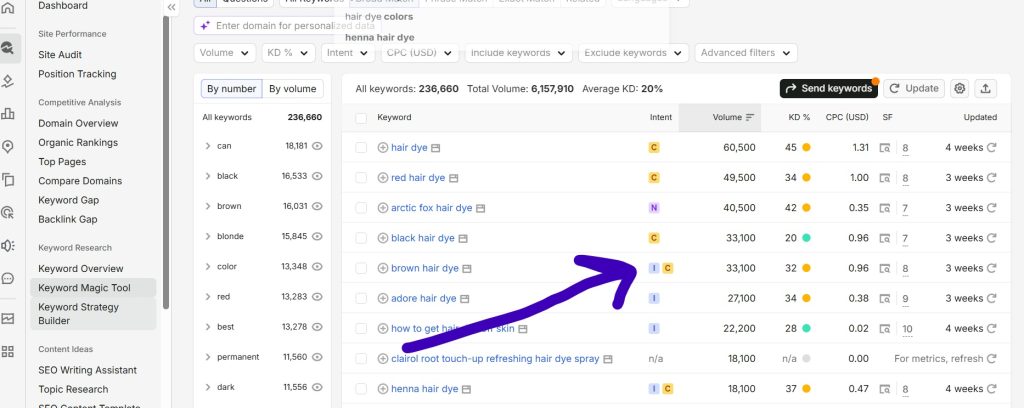
Is it Commercial or Informational?
If it’s Informational (or marked with an I), it means the user is looking for information, so your content should educate and guide them.
But if it’s Commercial, it means the user is either ready to buy or very close to making a purchase, so your content should match that stage of the buying journey.
Another thing you can do before writing is simply search your keyword on Google.
Look at the pages that are already ranking at the top.
If the top three results are mostly videos, chances are you should include a video too if you want a better shot at ranking.
If they’re mostly informational articles, then that’s probably the direction you should take as well.
Another great strategy is using the Skyscraper Technique.
Search your target keyword and carefully study the articles ranking in positions one through three.
See which topics, headings, and subheadings they cover.
Then create something that’s much more comprehensive, more useful, and more complete than theirs while fixing the weaknesses they missed.
All of these things help you create content that’s actually worth reading and has a much better chance of ranking well.
By the way, at Digital Zarin, we also offer SEO content writing services. So if you’d rather save time and leave the work to people who do this professionally, we’d be happy to help create high-quality content for your website.